


Integrating the Rotoweld 3.0 into Your Existing Pipe Fab Workflow


Bringing a Rotoweld 3.0 onto your fab shop floor isn't just an equipment purchase — it's a workflow transformation. As the industry's most advanced fully automated pipe spool welding system, the Rotoweld 3.0 uses AI-powered machine intelligence to track the weld puddle and make real-time adjustments, welding from root to cap with minimal operator intervention. But integrating it successfully means thinking beyond the machine itself.
This guide walks through what actually changes when a Rotoweld hits your shop floor — from layout and material flow to labor allocation and QC — so you can plan the integration, not just the purchase.
What the Rotoweld 3.0 Actually Does
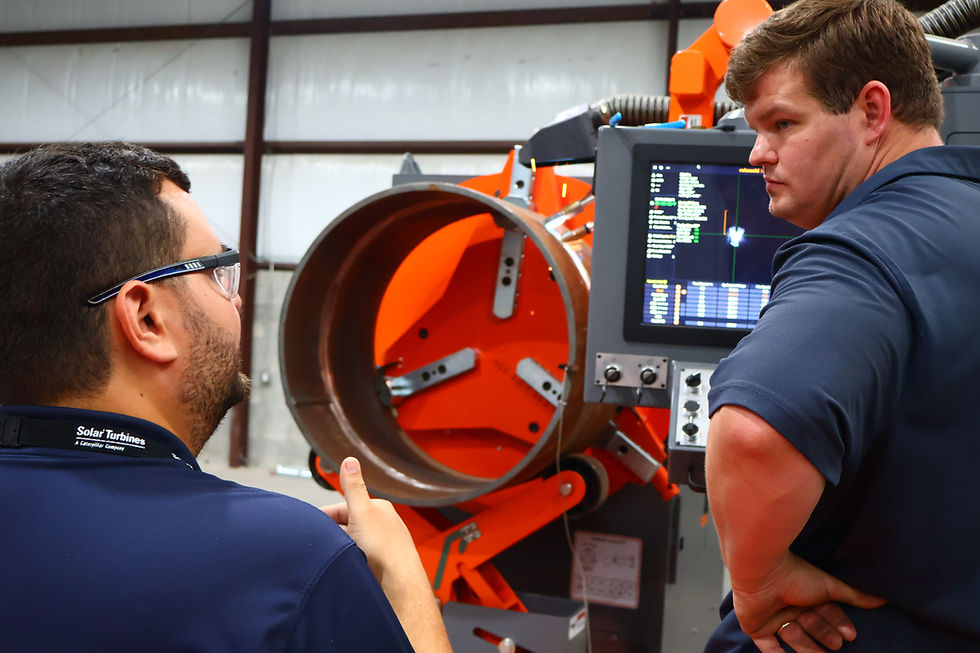
Before talking integration, let's define what you're bringing in. The Rotoweld 3.0 is a fully automated orbital welding cell that handles the entire weld sequence on pipe spools. It features dual welding torches — one dedicated to the root pass, another for fill and cap passes — each with independent wire feed and gas shielding. The system's AI tracks the weld puddle in real time and adjusts parameters to compensate for fit-up variations and material inconsistencies.
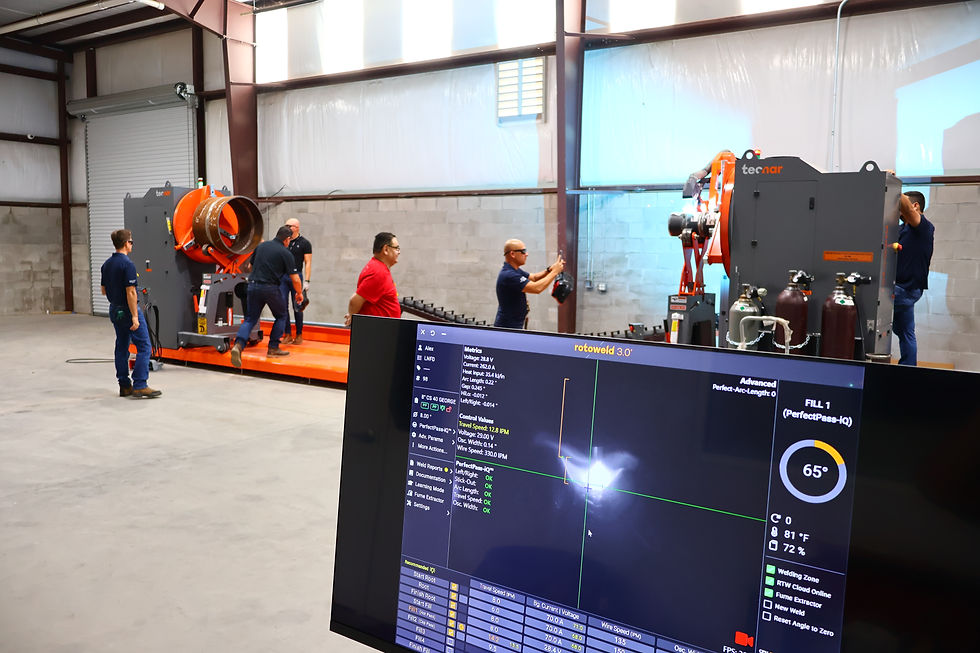
In practical terms, welding speed runs roughly 1 minute per inch of pipe OD for standard wall and 1.5 minutes per inch for heavy wall. The Twin Bay configuration takes efficiency further — load and prep your next spool on the second bay while the first is welding, pushing output up to 500 diameter-inches in a single 10-hour shift.
Floor Layout: Where Does It Go?

The Rotoweld isn't a small-footprint machine. You're bringing in a robotic welding cell that needs clear access for material loading, operator stations, and ventilation. The key considerations:
Inbound material staging — Pipe and fittings need to flow to the Rotoweld without bottlenecking. Ideally, the machine sits downstream of your cutting and beveling stations: raw material enters one side of the shop, cut and beveled pipe feeds the Rotoweld, and finished spools exit toward QC and shipping.
Utility connections — The Rotoweld requires power, shielding gas supply lines, and adequate ventilation for weld fumes. Plan your gas manifold location and electrical drops before the machine arrives.
Operator workspace — While the machine is automated, the operator still needs access for loading, monitoring, and occasional intervention. Leave enough clearance for a forklift or overhead crane to position heavy spools.
How Labor Shifts — It Doesn't Replace Welders, It Multiplies Them
One of the biggest misconceptions about the Rotoweld is that it replaces skilled welders. It doesn't — it amplifies them. One operator oversees the cell, and with the Twin Bay configuration, that single operator can keep two bays cycling. Output that previously required a crew of 3-4 welders can now come from one trained operator and a helper for material handling.
For shops struggling with the skilled labor shortage — and that's most shops — this is the Rotoweld's biggest value proposition. You're not solving the labor problem by finding more welders; you're solving it by getting more production from the welders you already have.
Training is straightforward but not trivial. An experienced pipe welder or welding technician can learn to operate the Rotoweld effectively with proper instruction. The key skills shift from manual torch manipulation to parameter setup, machine monitoring, and quality verification.
Quality Control: From Inspection to Verification
Manual TIG welding quality varies by welder, by day, and by joint. The Rotoweld removes that variability. Weld parameters are qualified once, then replicated across every joint — every root pass, every fill, every cap. This is critical for industries where traceability and repeatability matter: high-purity process piping, high-pressure pipeline systems, nuclear, semiconductor, and pharmaceutical applications.
Your QC workflow transitions from catching defects after the fact to verifying that the machine's parameters are maintained within spec. The Rotoweld's intelligent power supply provides real-time monitoring and data logging, so you have a digital record of every weld — not just a visual inspection report.
What Needs to Be in Place Before It Arrives
A Rotoweld integration succeeds or fails on preparation. Here's your pre-delivery checklist:
1. Pipe prep quality matters more, not less. The Rotoweld's AI compensates for some fit-up variation, but the better your incoming material is cut and beveled, the faster and more consistent your output. If your current cutting process produces inconsistent results, address that first — ideally with a precision CNC pipe profiling machine like the HGG ProCutter.
2. Define your target spool types and sizes. Know which spool configurations will run through the machine and which will stay on manual stations. This determines workflow routing and helps you forecast utilization.
3. Identify your operator. Choose someone who understands welding fundamentals and is comfortable with digital interfaces. A welder with orbital welding power supply experience will transition quickly.
4. Plan for consumables and maintenance. The Rotoweld uses contact tips, gas lenses, and other consumables that need regular replacement. Stock them before the machine arrives and set up a scheduled maintenance routine — an automated machine that's down for lack of a $12 consumable is a very expensive paperweight.
Realistic ROI: What to Expect
The Rotoweld is a significant capital investment. The return comes from three places:
Throughput — Welding speed of roughly 1 minute per diameter-inch means a 12-inch standard-wall spool welds in about 12 minutes, root to cap. The Twin Bay configuration eliminates idle time during loading and unloading, pushing arc-on time significantly higher than manual stations.
Labor efficiency — One operator producing what previously required 3-4 welders changes your labor math fundamentally. In a tight labor market, this is often the deciding factor.
Rework reduction — Automated, parameter-driven welding dramatically reduces reject rates. When every weld is executed to the same qualified parameters, rework drops — and rework is one of the largest hidden costs in any fab shop.
Most shops see payback within 12-18 months on a single-shift operation, faster with multi-shift utilization. The shops that see the fastest ROI are those running repetitive spool configurations at volume — data center chilled water piping, process piping for industrial facilities, and any application where the same joint configurations repeat across dozens or hundreds of spools.
Is Your Shop Ready?
The Rotoweld 3.0 isn't for every shop. If you do primarily one-off custom work with constantly changing configurations, the setup time may eat into your efficiency gains. But if you're running production spools — even in batches — with repeatable joint configurations, this machine changes the economics of your fab operation.
GSI Machinery has helped shops across the Gulf Coast region integrate Rotoweld systems into their existing workflows. From initial consultation through installation and operator training, we work with your team to make sure the machine hits the floor running — and keeps running.
Contact us to schedule a demo or discuss whether the Rotoweld 3.0 is the right fit for your shop.
