


Orbital Welding vs. Manual TIG: When Automation Wins (and When It Doesn't)

Updated: Sep 7

The decision between orbital welding and manual TIG isn't always straightforward. Both have their place in modern pipe fabrication, and the right answer depends on your specific application, volume, and quality requirements. This article breaks down the real tradeoffs — not the marketing claims.
Where Orbital Welding Wins
Repeatability is the orbital welder's superpower. Once weld parameters are qualified, the machine replicates them across every joint — same amperage, same travel speed, same gas coverage, same result. For applications where traceability and consistency are non-negotiable, this alone can justify the investment.
High-purity applications — semiconductor process piping, pharmaceutical-grade tube systems, food and beverage lines — are the strongest use case. In these environments, even minor variations in weld penetration or heat input can create contamination points or flow disruptions. Orbital welding eliminates that variability.
Orbital also excels on thin-wall tubing. Welding 0.065-inch wall stainless tubing manually requires exceptional skill and steady hands. An orbital system handles it predictably, every pass, without fatigue.
The labor equation is another win. One trained operator can oversee multiple orbital welding stations simultaneously — setting up the next joint while the previous one welds. In a market where skilled TIG welders are increasingly hard to find and expensive to keep, this changes the math significantly.
Where Manual TIG Still Makes Sense
Manual TIG isn't going anywhere. It's the right call in several common scenarios.
One-off and field work. If you're doing a single repair weld on an installed pipe at a job site, dragging an orbital power supply, weld head, and all the fixturing out there makes zero sense. A skilled TIG welder with a portable machine is the practical answer.
Tight-access joints. Orbital weld heads need clearance around the pipe — typically several inches of radial space. If you're welding a socket weld in a congested pipe rack where you can barely get a torch in there, manual TIG is your only option. The best orbital head in the world can't weld what it can't reach.
Heavy-wall, multi-pass on large diameter. While orbital can handle these applications, the setup time and tooling requirements for large-diameter heavy-wall pipe can eat into productivity gains. A skilled manual TIG welder with a positioner can often be more flexible on large-bore heavy-wall joints with complex configurations.
Low-volume, high-mix shops. If no two days look the same and you're welding different materials, diameters, and wall thicknesses constantly, the changeover time on orbital equipment can erode the efficiency gains. Manual TIG offers unmatched flexibility when variety is the norm.
The Hidden Costs on Both Sides
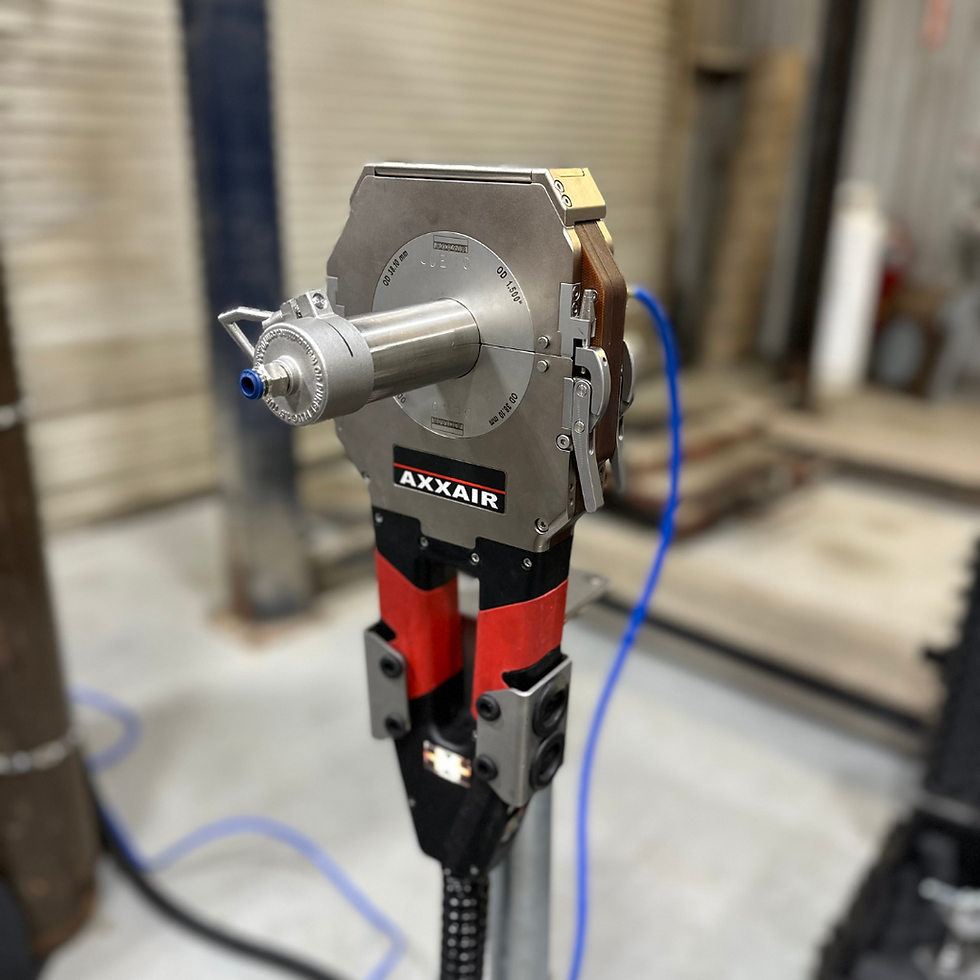
Orbital welding has upfront costs that go beyond the equipment. You need proper joint preparation — cut faces need to be square, bevel angles consistent, and fit-up gaps tight and uniform. If your current pipe prep isn't precise, you'll need to upgrade your cutting and beveling process first. The machine can't compensate for a poorly prepped joint indefinitely.
Manual TIG's hidden cost is the one everyone knows but struggles to quantify: variability. One welder on a good day, one on a bad day, a third who just started last month — the spread in quality, rework rates, and productivity is real. Over hundreds of joints, that variability compounds into significant cost.
Making the Call
Ask yourself three questions:
1. Are you welding the same or similar joints repeatedly? If yes, orbital automation will pay off. If every joint is different, manual TIG's flexibility wins.
2. Does your spec require documented consistency? If you're providing weld maps, material test reports, and traceability documentation, orbital welding gives you that data automatically — the power supply logs everything.
3. Can you find and keep skilled TIG welders? This is increasingly the deciding factor. If your labor market is tight (whose isn't?), orbital welding lets you produce more with fewer highly skilled hands.
For most fab shops, the ideal setup isn't either/or — it's both. Orbital for production spools and high-purity work where consistency drives value, manual TIG for field work, repairs, and one-off configurations. The shops that figure out where to draw that line are the ones that win on both quality and cost.
GSI Machinery supplies, services, and rents orbital welding equipment for shops across the Gulf Coast. If you're evaluating whether orbital welding makes sense for your application, reach out — we'll help you think through the real-world tradeoffs for your specific work.

