Why Orbital Welding is Ideal for Stainless Steel Tubes

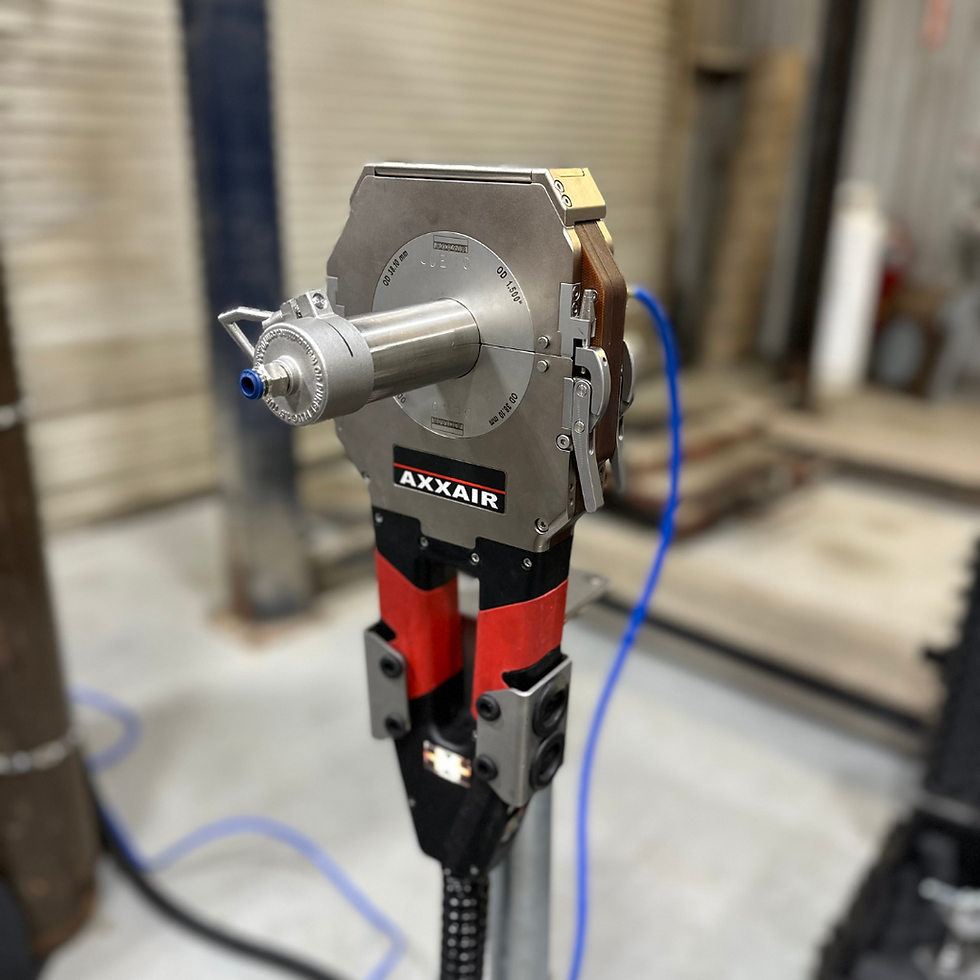
Orbital welding has many applications across many different industries. One that we feel it is exceptionally well suited for is fusing relatively thin wall stainless steel tubes. In this application orbital welding offers unmatched precision and consistency, especially on small diameter or tubes in tight spaces that can pose a challenge to weld by hand. This automated welding process utilizes a rotating tungsten electrode that travels around the circumference of the tube at a precise and controlled speed with precise and controlled heat input (by utilizing a simple pulsed TIG process), which creates a uniform weld (if the joints are prepped and fitted correctly). Stainless steel, widely used in industries like pharmaceuticals, aerospace, and food processing due to its corrosion resistance and durability, demands high-quality welds to maintain its integrity. Orbital welding meets these demands by minimizing human error, ensuring repeatability, and producing clean, strong, x-ray quality welds. Its ability to deliver consistent results makes it a go-to choice for applications where weld integrity and hygiene are non-negotiable.

One of the primary advantages of orbital welding for stainless steel tubes is its ability to consistently make high quality welds, even in tight spaces on small diameter tubing. The process uses a computer-controlled system to regulate parameters such as gas purge pressure, electrode travel speed and current (both background and primary amperage), ensuring a uniform, fully penetrated weld every time. This is critical for stainless steel, as inconsistencies can lead to weak points or contamination risks in critical applications like pharmaceutical piping or semiconductor manufacturing. Unlike manual welding, which relies heavily on the skill of the welder, orbital welding reduces variability, producing smooth, defect-free welds that meet stringent industry standards, such as those set by ASME or FDA.

Another key benefit is the cleanliness of orbital welding, which is essential for stainless steel tubes used in hygienic environments. The process is typically performed using a closed head orbital welding system which encases the weld joint bathing it with the shielding gas of choice for the application (typically argon for stainless applications). This ensures oxidation and contamination will not affect the weld. This results in welds with minimal heat-affected zones (HAZ) with no sugaring or porosity, preserving the corrosion-resistant properties of stainless steel. For industries like food and beverage or biopharmaceuticals where contamination can compromise product safety, orbital welding negates this risk by ensuring a clean, non-porous weld that prevents bacterial growth and meets sanitary requirements.
Orbital welding also enhances efficiency and cost-effectiveness in stainless steel tube welding. While the initial investment in equipment can be high (although GSI Machinery helps mitigate this risk with rentals and rental credit to own), the automation reduces labor costs and rework by minimizing defects and in many circumstances has a faster weld cycle time. The process is faster than manual welding for repetitive tasks, as it can be programmed to weld multiple joints with identical quality. This repeatability is particularly valuable in large-scale projects such as data center, food & dairy or semi-conductor manufacturing facility construction, where stainless steel tubes are plentiful. Over time, the reduced need for repairs and skileld labor challenges offsets the upfront costs, making orbital welding a financially sound choice.
All in all, orbital welding’s consistency makes it well-suited for stainless steel tubes across various applications. It can handle a range of tube diameters and wall thicknesses, adapting to the specific needs of industries like oil and gas, semi-conductor, data center, pharmaceutical, nuclear, or medical device manufacturing. By combining precision, cleanliness, efficiency, and repeatability, orbital welding stands as an optimal method for welding stainless steel tubes, ensuring high-quality results that meet the rigorous demands of critical industries.
GSI Machinery